
Inside Finn Juhl's House in Copenhagen: A Tour of Danish Modern Interior Design

Watch the full Home Tour on our YouTube Channel. Click here 🎥
✨A Danish Design Masterpiece: Inside Finn Juhl's Visionary Home
Step inside Finn Juhl's House in Copenhagen: A Tour of Danish Modern Interior Design
This isn't just a residence.
It's a laboratory where one of Denmark's most influential designers shaped the language of modern design.
Every surface, every curve, every material choice reflects decades of visionary thinking about how we live.
The house consists of two blocks forming an L-shape, creating intentional niches and layers within the floor plan.
What strikes you most isn't the iconic furniture or the carefully curated art collection (though both are staggering).
It's the philosophy embedded in every decision.
Furniture and architecture aren't separate disciplines here.
They're inseparable partners in creating how we experience space.

Sculpture Over Straight Lines
The Power of Organic Form
Unlike his contemporaries, Finn Juhl designed each furniture piece from scratch, using only the dimensions of his own body as reference.
This created a revolutionary approach.
Every curve, every joint, every connection feels sculpted rather than constructed.
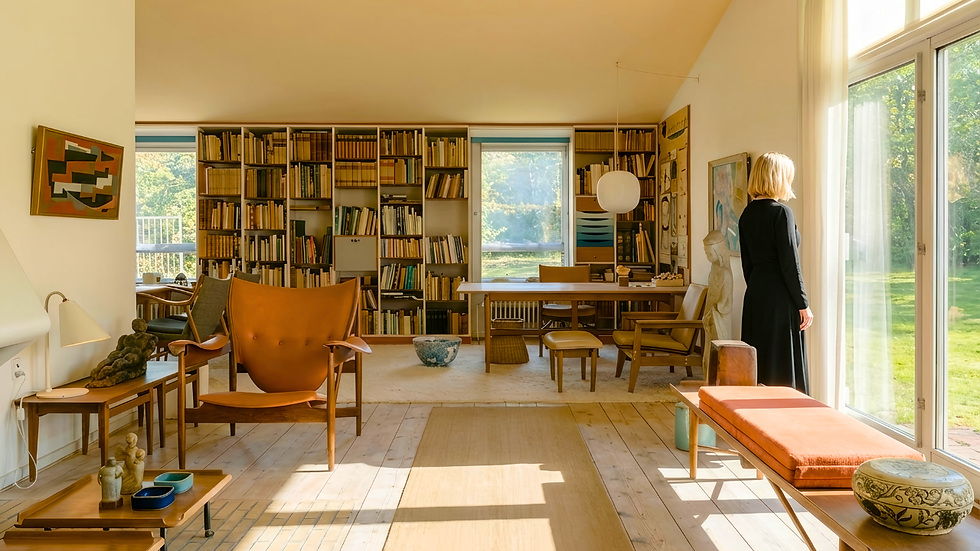
Look at the Chieftain Chair, perhaps his most daring work.
There isn't a single straight piece of wood.
Every element curves, flows, responds to the human body.
It's so refined, so deliberately organic, that you feel the movement embedded in the object itself.
The Poet's Sofa sits opposite it, and together they become a conversation in form.
One daring and masculine, the other soft and elegant.
What to Learn:
Don't settle for standard.
When designing a space, especially when selecting statement pieces, ask yourself: does this object feel alive? Does it move?
Look for furniture with deliberate curves and organic proportions rather than strict geometric forms.
Pair sculptural pieces with negative space so they can breathe.
The magic happens when a single chair becomes a presence in the room.
Bigger Picture:
This teaches us that form follows function, but not in the mechanical way we often think.
True design literacy means recognizing that how something moves through space, how it catches light, how it invites touch, matters as much as what it does.
Painting the Fifth Wall
Color as Psychological Space
In every room of this house, Juhl painted the ceiling a different color.
In the living room, it's soft mustard yellow.
In the office, lemon zest.
The living room color palette itself is masterful: warm browns, cognacs, soft taupes, off-whites, and muted sage create a sophisticated analog color story.
But that painted ceiling? It changes everything.
The warm yellow creates the sensation that the sun itself is draping the room in a loving glow.
It makes you feel held.
What to Learn:
Most people fear painting ceilings.
They worry the space will feel heavy.
The opposite is true.
A warm-toned ceiling creates comfort.
Start with neutral walls to give yourself a calm base, then introduce your bold ceiling color.
If you're timid, try a soft mustard, pale yellow, or warm gray first.
Pair it with warm wood and warm metallics to amplify the effect.
The ceiling is your fifth wall. Use it.
Bigger Picture:
Understanding that every color decision is a psychological one.
Ready to master ceiling color? Explore our Color Course to understand warm tones, psychological color impact, and how to layer colors confidently across all five walls. Click here 🎥✨
The Layered Interior
When Furniture Becomes Architecture
In the entryway, a bold blue seating area sits beneath built-in glass shelving and integrated planters.
The shelving isn't applied to the wall.
It's woven into the architecture itself.
The planter isn't a separate object.
It's structural.
This blurred line between furniture, decoration, and architecture is Juhl's signature.
Similarly, instead of using a carpet to zone the living room seating area around the fireplace, Juhl used bricks.
Bricks that function like a carpet, defining the space, but with honest, raw materials.
It's unconventional and deeply intentional.
What to Learn:
Design thinking means asking: what's the real function here?
If you need to zone a seating area, you don't need a carpet.
You need something that marks the space.
Could it be bricks, tiles, a level change, or integrated built-ins?
Start thinking of furniture as permanent architectural elements rather than temporary objects.
Built-in shelving, integrated seating, and intentional materiality create spaces that feel like they were born rather than decorated.
Bigger Picture:
This reveals the heart of true design: holistic thinking.
Your sofa isn't just a sofa.
It's part of the architecture of how you live.
Your walls aren't just walls.
They're opportunities for integrated function.
When you think this way, spaces stop feeling decorated and start feeling inevitable.
The Paradox: Maximalism Through Restraint
What's fascinating about Juhl's home is its paradox.
It's full of art, filled with iconic furniture, layered with collected treasures.
Yet it never feels crowded or like a museum.
Why? Because every object earned its place.
There's nothing casual here.
The art on the walls was collected thoughtfully. The furniture was designed by him. Each material choice serves a purpose.
The same philosophy applies everywhere: design with intention, remove anything that doesn't earn its place.
How to See Design Like Finn Juhl
Finn Juhl's home is a manifesto in form.
It shows us that true design isn't about following trends or making things pretty.
It's about understanding that architecture and furniture, color and light, materiality and movement are all conversations about one thing.
How we choose to live, and what that choice says about us.
Watch the full Home Tour on our YouTube Channel. Click here 🎥


Comments