
Inside Finn Juhl's House in Copenhagen: 3 Interior Design Lessons from Denmark's Most Influential Designer

The first thing you notice in Finn Juhls home in Copenhagen is the ceiling. Not the Chieftain Chair, not the art collection, the ceiling, painted a warm mustard yellow that seems to hold the whole room in place.
This is Finn Juhl's own house in Copenhagen, built in 1942 and lived in by the architect and designer himself until his death in 1989. He designed nearly every piece of furniture in it from scratch, using his own body as the only reference.
What holds it together is intention. Every curve, every color, every material choice earns its place, which is why a house this full of iconic design never reads as crowded.
Watch the Full Home Tour on our YouTube Channel: Click here 🎥✨
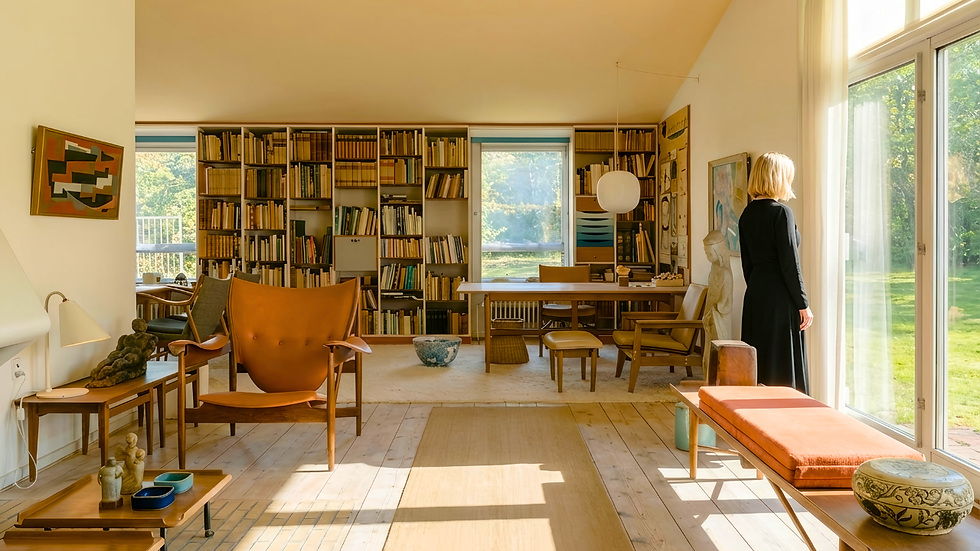
Finn Juhls Furniture is Sculpted From the Body
Juhl designed each piece using only the dimensions of his own body as reference, not standard measurements or straight lines. The Chieftain Chair, his most daring work, has not a single straight piece of wood in it. Every element curves, flows, and responds to the body that sits in it.
The Poet's Sofa sits opposite it, one daring and masculine, the other soft and elegant, and together they read as a conversation in form rather than a matched set.
What to Learn: Look for furniture with deliberate curves and organic proportions instead of strict geometric forms. Give a sculptural piece negative space around it so it can read as a presence in the room, not just an object filling a corner.
Bigger Picture: A chair like this proves that form follows function in a way that has nothing to do with efficiency. How something moves through space and catches light matters as much as what it does.
If you are struggling what furniture actually earns its place in your own home before buying anything new, the Interior Workbook has templates for exactly that :)
Shop Items from this Home:
Affiliate Disclosure: Some links in this article are affiliate links, meaning I may earn a commission if you make a purchase, at no extra cost to you.
A Painted Ceiling Becomes a Fifth Wall
Juhl painted the ceiling a different color in nearly every room. Soft mustard yellow in the living room. Lemon zest in the office. The walls stay in a restrained palette of warm browns, cognacs, soft taupes, and muted sage, so the ceiling is what changes the temperature of the whole room.
The warm yellow overhead does not make the living room feel heavy. It makes it feel held, like the sun is draped across it.
What to Learn: Most people avoid painting ceilings because they worry the room will feel smaller or heavier. It rarely does. Start with neutral walls as a calm base, then introduce a bold ceiling color. A soft mustard, pale yellow, or warm gray is a low-risk place to start, paired with warm wood tones and warm metallics to amplify the effect.
Bigger Picture: Every color decision in a room is a psychological one, including the one surface most people never think to paint. The Interior Color Masterclass covers exactly this, how to read warm and cool tones and layer color with intention across all five walls, ceiling included.

Bricks Replace the Rug as a Zoning Tool
Instead of using a rug to define the living room seating area around the fireplace, Juhl used bricks set into the floor. The bricks function exactly like a rug would, marking the boundary of the space, but in a raw, honest material that reads as architecture rather than decoration.
The same logic shows up in the entryway, where built-in glass shelving and an integrated planter are woven into the wall rather than applied on top of it. Nothing here is a separate object added afterward. It is structural from the start.
What to Learn: Before reaching for a rug to zone a seating area, ask what else could mark that boundary. A material change, a level change, or a built-in element can do the same job with more permanence. Start treating furniture and fixtures as architectural decisions rather than temporary ones.
Bigger Picture: A sofa is never just a sofa, and a wall is never just a wall, once you start seeing them as part of the architecture of how you live. Spaces built this way stop feeling decorated and start feeling inevitable.
What Finn Juhl's house proves is that maximalism and restraint are not opposites.
A room this full of iconic furniture and collected art never feels crowded, because nothing in it was chosen without a reason.
Watch the Full Home Tour on our YouTube Channel: Click here 🎥✨
Comments