
Interior Design in Classical Copenhagen: 3 Interior Lessons from the Home of Artist Bjørn Agertved

Updated: Apr 7

This house by artist Bjørn Agertved makes a statement before you even step inside. A 260 square meter Copenhagen home where classical architecture meets bold contemporary design.
Watch the Full Home Tour on our YouTube Channel: Click here 🎥✨
Design Insight #1: The Power of Monochromatic Anchors
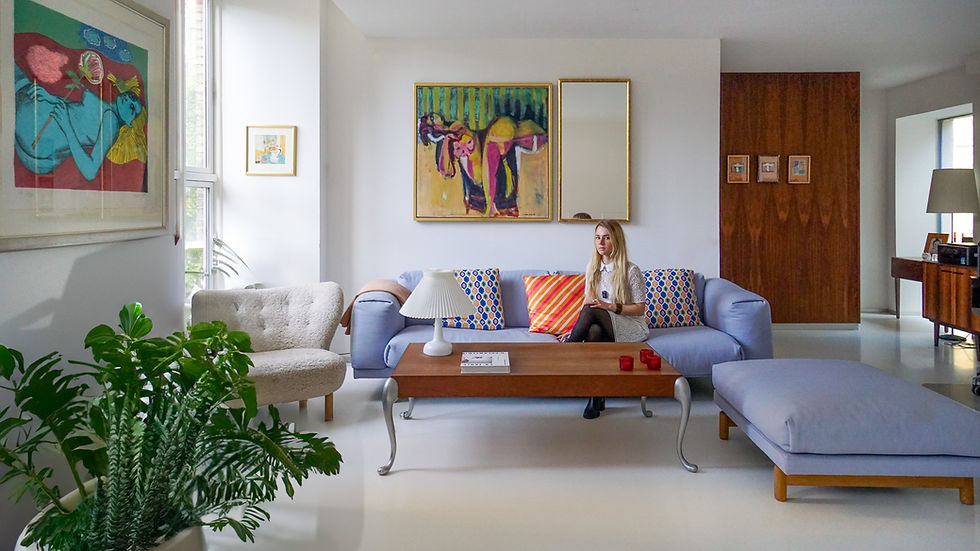
When a room is full of art, the walls have one job: disappear.
In a house filled with art, the walls don't compete. Paintings pop. Sculptures breathe. The art becomes the color story.
This is a harder thing to achieve than it looks. The instinct, when you love art and objects, is to also choose interesting wall colors, interesting textiles, interesting everything. But a room where every surface has an opinion becomes exhausting to read. Here, the decision to keep the walls completely neutral is itself a curatorial choice.
Want to go deeper in interior design? Use our Interior Journal to plan how art collections can anchor your color story. Click here 🎥✨
Why This Matters
The lesson underneath it: neutrality is not a lack of taste. It is a decision about where to focus yours.
What to Learn:
If you're collecting art or have pieces you care deeply about, surrender your wall color to your collection. Use black, white, soft gray, or warm neutrals. Let your art be the color story. Use your Interior Journal to document how neutral walls make your art stronger, how they create focus, how they turn your home into a gallery.
Design Insight #2: Pink Marble as Identity
Pink marble is bold. It's unexpected. In a classical home, it's almost rebellious. But that's exactly why it works.
Most people who live with classical architecture play it safe. They choose materials that disappear. Travertine. White Carrara. Anything that defers to the columns, the cornicing, the inherited geometry. That instinct isn't wrong. But it produces rooms that feel preserved rather than lived in.
Bigger Picture:
Design evolution happens when we're brave enough to question inherited rules. This marble isn't disrespectful to the classical architecture. It's in conversation with it. It says: you're beautiful, and I'm adding my own voice.
Design Insight #3: Gallery Curation as Interior Design
This home isn't decorated with art. It's designed around it.
That distinction matters more than it sounds. Most people hang art after the room is finished.
Here, it works the other way. Pieces are positioned with intention. Spacing is deliberate. Sight lines are considered from across the room, not just from directly in front. The arrangement asks you to move through the space in a specific way.
Why This Matters
A well-curated space feels intentional. It feels like someone made thoughtful decisions. It feels alive.
Curation is a form of editing. And editing, in interior design, is what separates a space that looks collected from one that looks considered.
Watch the Full Home Tour on our YouTube Channel: Click here 🎥✨


Comments